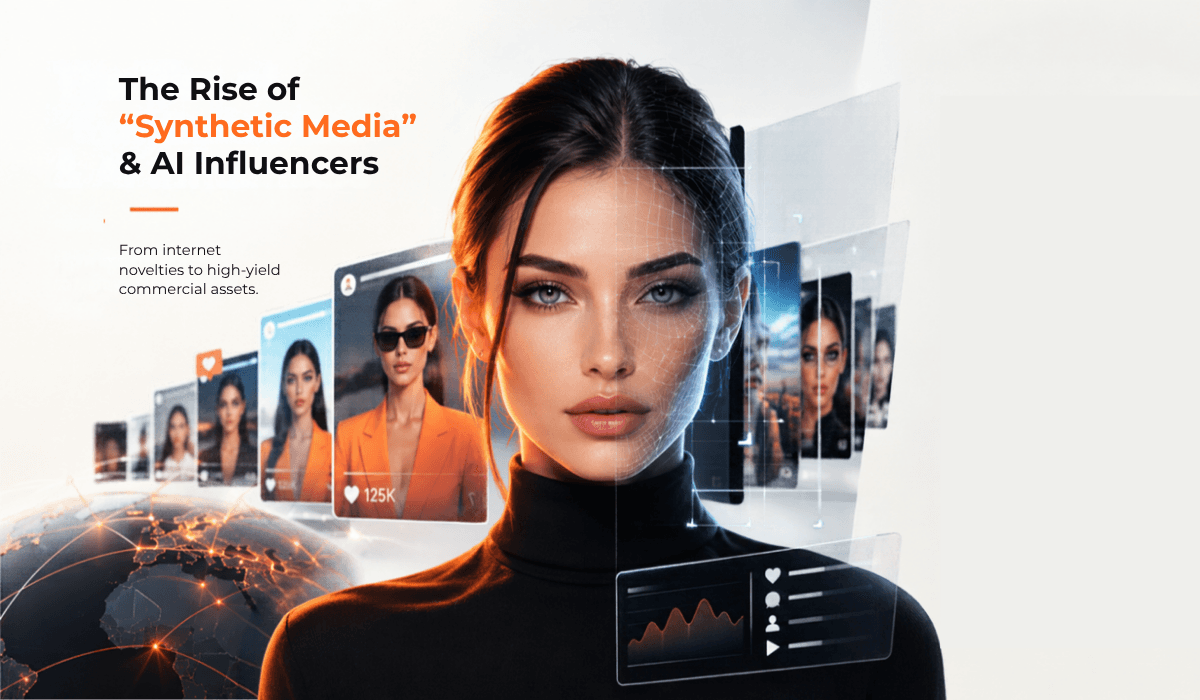
Some of the faces selling clothes, supplements and phones on Instagram belong to nobody. A studio renders them, writes their captions and schedules their posts, and a growing number of brands pay them the way they would pay a human creator.
Synthetic media is the umbrella term for images, video and voices that software generates or heavily alters. AI influencers are its most visible use in marketing. For a brand, the question is no longer whether the technology works. It is whether a persona it fully controls is worth what it costs in trust.

From novelty to line item
Lil Miquela, a computer-generated teenager run by the Los Angeles startup Brud, started posting in 2016 and went on to appear in campaigns for fashion brands such as Prada and Calvin Klein. For years she was treated as an art project. That changed once image models made a convincing persona cheap to produce.
In 2023 the Barcelona agency The Clueless launched Aitana López after, by its founder’s account, it kept losing bookings to unreliable human models. The agency says she earns up to €10,000 in a good month and around €3,000 in an average one. Those figures come from her creators, not an audit, but they show the business model: a small design team, a content calendar, and no travel budget.
What brands get
Control
Every pose, caption and reply is approved before it goes out. There is no off-brand livestream, no old post resurfacing at the wrong moment, and no exclusivity clause broken for a competitor.
Output
A synthetic presenter can appear in fifty languages and ten markets on the same afternoon. Localizing a campaign stops being a casting problem and becomes a rendering job.
Ownership
The brand or its agency owns the character. When a human ambassador leaves, the audience often follows them out the door. A synthetic one stays.
What they don’t get
Control is not the same as low risk. The risk moves from the person to the operation behind them.
- Trust. People follow creators because they believe a real person stands behind the recommendation. A persona that praises a moisturizer it has never used asks for a different kind of trust, and the brand has to earn it some other way.
- Disclosure law. The US Federal Trade Commission’s 2023 update to its Endorsement Guides names virtual influencers as endorsers, so the disclosure rules for human creators apply to them too. In the EU, Article 50 of the AI Act has applied since August 2, 2026. It requires generated or manipulated images, audio and video that could pass as real to be disclosed as artificially generated, and a photorealistic persona is exactly the kind of content that rule was written for.
- Platform rules. Instagram, TikTok and YouTube all ask creators to label realistic AI-generated content, and accounts that skip the label risk reduced reach or removal.
- Running costs. A believable persona needs art direction, writing, community management and someone who answers comments in character. Production gets cheaper. The team behind it does not disappear.
How to use it without spending your audience’s trust
The brands that use synthetic media well treat it as a format, not a disguise.
- Label it everywhere, in the bio and on every sponsored post, before a platform or a regulator asks you to.
- Keep people in charge of anything that sounds like personal experience. A synthetic persona can present a product. It should not claim to have used it.
- Keep the source files, prompts and approvals for every published asset, so you can show how a piece of content was made if anyone asks.
- Measure trust as well as reach. Compare comment sentiment, saves, return visits and conversions against your human creators before you scale up.
Where we stand
Fusion Forge Tech builds software and AI integrations, including the content pipelines, approval workflows and analytics this kind of marketing runs on. Our view is simple. Synthetic media is a production tool. Used openly, it lets a small team publish like a large one. Used to fake a person, it spends the trust that marketing exists to build.
If you are planning a campaign with generated content and want the pipeline and the disclosure built in from the start, tell us what you are building.